Download Thesis: PDF
Download Source Code: ZIP-File
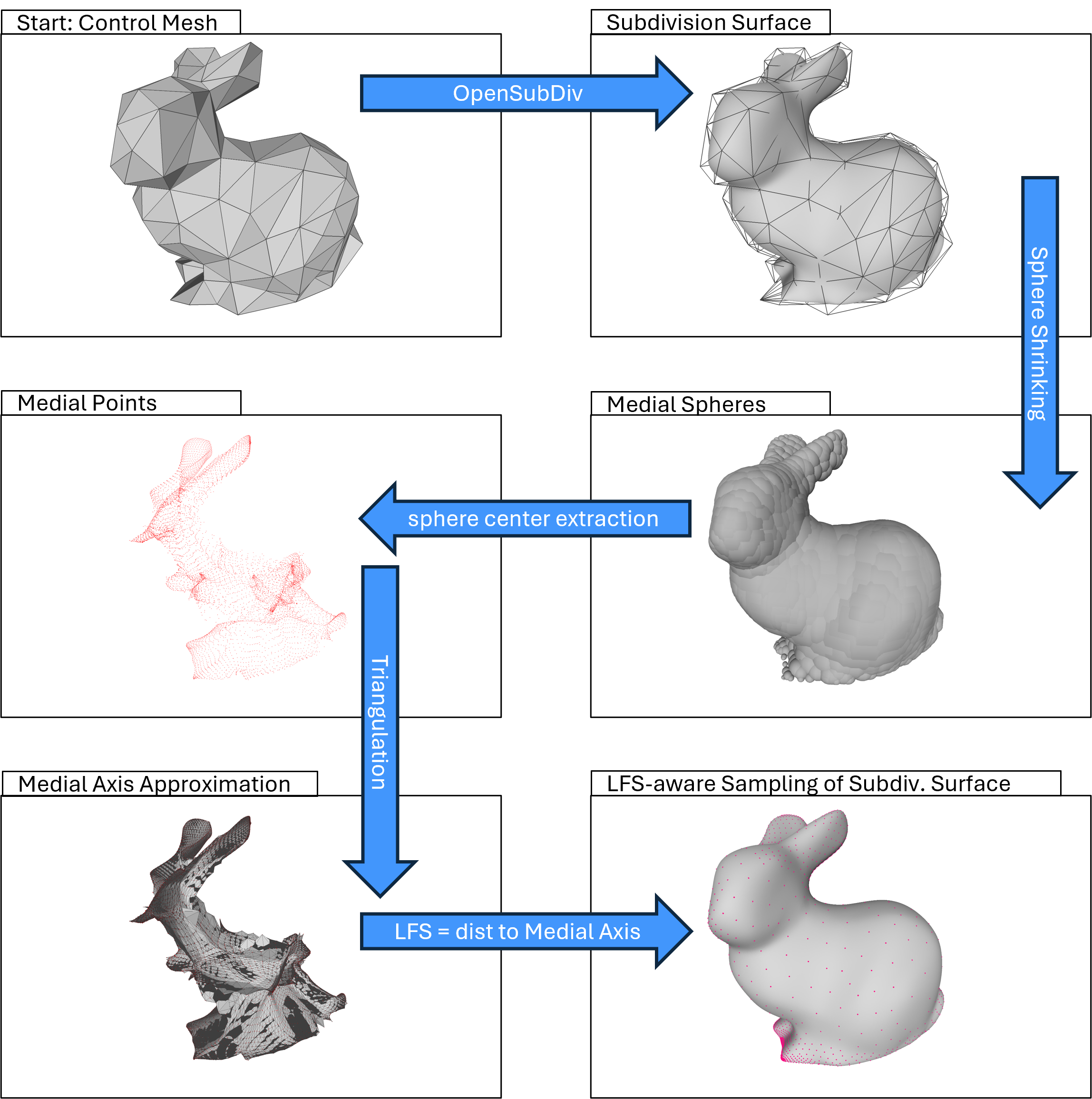
The medial axis (MA) of a closed surface and the local feature size (lfs) it induces are important descriptors in geometry processing. For triangle meshes, the lfs vanishes at vertices and edges, causing branches and leaves on the MA, which classical methods for MA approximation of meshes remove by carefully tuned, mesh-specific pruning heuristics. This thesis avoids these instabilities by computing the MA directly on a smooth Loop subdivision surface of a triangle mesh. This thesis introduces a four-step pipeline that takes a closed triangular control mesh as input and computes a triangulation of a lfs-aware sampling of its subdivision surface. First, the MA is sampled by growing at each foot point of a uniform tessellation of the Loop subdivision surface, a maximal empty tangent sphere. This reduces the problem to a one-dimensional binary search in the sphere radius, in which each candidate is evaluated by a Newton-scheme-based closest-point query on the subdivision patches. The obtained sphere centers are points on the MA. Second, these points inherit the combinatorics of the foot-point tessellation, which yields a manifold, possibly self-intersecting mesh and thus a triangle soup used for fast distance queries for the lfs. Third, for a parameter ε, that controls the average sampling density, an ε-sampling of the Loop subdivision surface is created with this MA by recursively subdividing each patch in its parameter domain until an enclosing sphere proxy, justified by the 1-Lipschitz continuity of the lfs, certifies the ε-condition over the whole sub-patch. This local criterion is proven to be sufficient to guarantee an ε-sampling of the entire surface. Fourth, the samples are triangulated per patch via a constrained Delaunay triangulation in parameter space, with shared patch boundaries enforced as constraints to produce a consistent manifold output mesh. Since no closed-form solution for the MA of a Loop subdivision surface is available, the method is validated empirically. Compared against the state-of-the-art methods, the proposed approach captures fine medial features already at low tessellation levels and reaches a precision that competing methods attain only at substantially higher resolutions and after manual pruning, while its accuracy is controlled only by a single, monotone resolution parameter rather than per-mesh tuning. Practical applications are presented in shape recognition pipelines, rendering of subdivision assets, and evaluation of surface reconstruction algorithms.