Download: PDF
After an introduction and a literature survey on continua with first and second deformation gradients, the necessary basics and notation from tensor analysis, differential geometry, functional analysis and continuum mechanics are briefly presented. The following main part of the thesis consists of four parts, each of which has a chapter dedicated to it. The first part recapitulates a mathematical method for the derivation of generalized stress tensors of order two, three and four (henceforth referred to as stress tensors), which are work-conjugate to the first, second and third spatial velocity gradients. All the basic mechanical equations including the principle of virtual power and the associated boundary conditions for the present case can be derived from the presented method.
In the second part, a framework for elasticity is developed. First, work-conjugate material deformation variables and stress variables are derived, and their transformation behavior when changing the reference placement is determined. Then, the basic concepts of the elastic isomorphism and material symmetry are generalized for the present case.
In the third part, a framework for elastoplasticity is developed. First of all basic terms and concepts such as elastic regions, yield criteria and elastic isomorphisms are introduced and generalized to the present case. Then the plastic dissipation is calculated and flow and hardening rules are adapted to the present case.
In the fourth part it is proved that the model is thermodynamically consistent. For this purpose, the concepts mentioned above are derived again assuming the first law of thermodynamics and the Clausius-Duhem inequality.
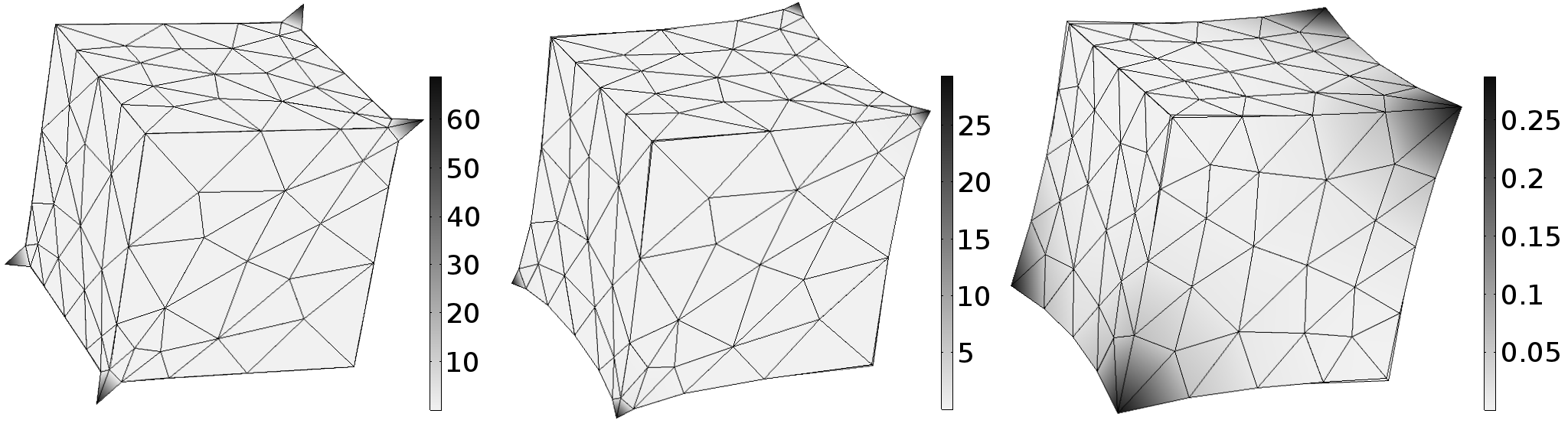
The fifth part of this paper presents the results of a numerical simulation with finite elements. Using Lagrange multipliers, an elastic material model was implemented for small deformations which includes the second and third displacement gradients. This is applied to polyhedra with displacement boundary conditions at vertices and edges. In most cases, the solutions do not show any signs ofsingularities in the displacements or the mechanical performance. It is explained why a third-order theory is necessary to obtain these results, which can be seen as one of the motivations for setting up the framework described above.
The appendix explains how the framework in parts one to four can be used with another, equivalent deformation variable, and why the use of material gradients of the gradients of the right Cauchy-Green tensor as deformation variables would unnecessarily complicate the framework. It turns out that so-called pullbacks of the deformation gradients are the most suitable form for the presented framework.